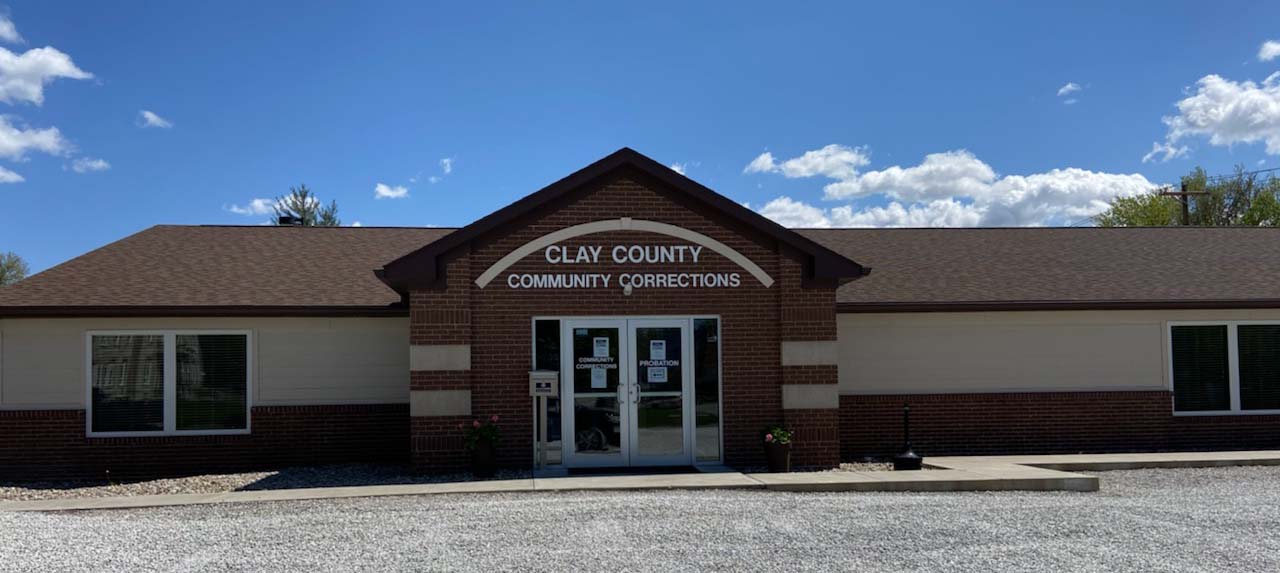
 Clay County Community Correction’s Vision
The vision of Clay County Community Corrections is to successfully divert non-violent adult and juvenile offenders from incarceration at the state level through electronic home detention, intense supervisory, educational programs and the Community Transition Program.
Clay County Community Correction’s Mission
Our mission is to promote successful re-entry of offenders into the community, to create positive personal changes in the lives of the participants and to reduce recidivism rates by utilizing Evidenced Based Practices.
Programs
Home Detention
Description & Target Population:
Clients are referred to Community Corrections for pre-screening through their attorney, prosecuting attorney or Court in order to defer incarceration in our local jail or the Department of Correction. Probation may also recommend to the Prosecuting Attorney to utilize Electronic Home Detention in lieu of further incarceration. Clients who are placed on GPS electronic monitoring will be randomly visited by the home detention/surveillance officer or met with their Case Manager. High risk clients will receive a minimum of one (1) visit per week, moderate risk clients a minimum of two (2) visits per month, low risk clients will receive a minimum of one (1) visit per month. Case plans for those participants serving more than 90 days, a direct commitment and moderate to high risk are developed on a monthly review.
Target population:
The targeted population for this proposal is post-convicted male and female felony incarcerated individuals who score within the moderate to high range on the Indiana Risk and Needs Assessment tool. According to the risk principle of effective correctional intervention, treatment and accountability interventions should be used primarily with higher risk incarcerated individuals. Generally speaking, males, females, veterans, adult and juvenile non-violent offenders, whose offenses is currently a Level 1, 2, 3, 4, 5 or 6, or Class A, B, C or D felony who score moderate to high on the risk and needs assessment fall into this targeted population.
COMMUNITY TRANSITION
Description & Target Population:
Once notification and report is received from the Department of Correction, we look at their intended residence. If the residence is out of county, we refer the case to the residing county for transfer request.
If the offender plans on residing in Clay County, we contact the place of residence to explain the program, receive acceptance or denial from that residence and to make sure they know the Terms and Agreement of CTP. The offender is placed on Home Detention in our CTP Program.
If the offender has requested that he/she not be included into CTP, we honor their request.
On all cases, a report is made to the Court on acceptance or rejection for CTP. The Court will issue an Order denying or accepting offender into CTP.
Target population:
For Community Transition is Male/Female non-violent B, C, D felony, Level 1, 2, 3, 4, 5 and 6 offenders. The goal of the program is to assist in their re-entry back into our community, and to divert offender from the Indiana Department of Corrections.
DAY REPORTING (INCLUDES DRUG SCREEN PROGRAM)
Description & Target Population:
If an offender violates with Probation, sanctions may include the Drug Screen Program which is a drug screen incentive where the majority of our clients are referred to us by Probation. They enter into an agreement that states that drug screens will decrease in cost as long as they remain substance free. The judicial system may utilize the traditional Day Reporting component as a sanction in the same way as electronic home detention.
Clients are required to report daily to give their schedules for the next 24 hour period. Our home detention surveillance officer may check on them periodically. Case management plans for those participants serving more than 90 days, a direct commitment and are moderate to high risk. We also offer a daily call-in program for drug abuse offenders where clients are rewarded for clean drug screens by a reduction in fees.
We are also a reporting agency for Ignition Interlock for offenders.
Target population:
The target population in the most need of this component is offenders who score moderate to high on the IRAS. Generally, male or female, adult offenders, whose offense is a felony, will fall into this targeted population. Non-violent, medium to high risk offenders sentenced to either execute time up or as a term of probation.
COMMUNITY SERVICE RESTITUTION
Description & Target Population:
An offender is ordered by the Court to complete a specific number of community service restitution hours. This can also be done through a Pre-Trial Diversion Agreement. The client will sign a Community Service Restitution Terms and Agreement and then will be placed with a specific not-for-profit agency. Contact is maintained with all placement agencies in order to confirm placements, completion of hours, and any problems associated with the client’s placement.
We work with such agencies such as the Humane Shelter, Brazil City Parks Department, Brazil City Garage, Clay County Courthouse, Clay City Town Hall, YMCA and other surrounding county non for profits.
Target population: Misdemeanors and felonies ordered by the Court. Pre-trial and a term of sanction
Soberlink
Description & Target Population:
An Offender is either Court Ordered to complete this through Probation or it can be used as a sanction for electronic home detention. Soberlink is a portable breathalyzer wherein the offender is set up on a schedule where they get alerts on their cell phones to take a breathalyzer test.
Target population: Misdemeanors and felonies ordered by the Court. Pre-trial and a term of sanction
COPE (COURT ORDERED PLACEMENT FOR EDUCATION) – OUT OF SCHOOL SUSPENSION PROGRAM
Description & Target Population:
A juvenile is placed in this program after the school determines that they have qualified according to their Student Handbook, and the Judge has found probable cause that the juvenile has qualified. They appear before the Judge the first day of their suspension. The parent(s) or guardian(s) take the juvenile to the alternative school and every day thereafter. At the alternative school, a teacher’s aide is there to administer the work that they would have if they were in the classroom. The juvenile(s) get(s) credit for work done in this program. During one-half (1/2) of their school day, a Community Corrections Work Crew Supervisor picks the juveniles up wherein they will perform community service.
Target population: 6th grade through 12th grade students in the Clay County Community School District who have qualified for an out of school suspension according to the Student Handbook