Family Violence Prevention and Services Act
Grant Status Closed
The Family Violence Prevention and Services Act (FVPSA) authorizes the FVPSA grant program, which is administered by the U.S. Department of Health and Human Services (HHS), Administration for Children and Families (ACF), Office of Family Violence Prevention and Services (OFVPS). This grant program is intended to assist states in their efforts to support the establishment, maintenance, and expansion of programs and projects to 1) prevent incidents of family violence, domestic violence, and dating violence; 2) provide immediate shelter, supportive services, and access to community-based programs for victims of family violence, domestic violence, or dating violence, and their dependents; and 3) provide specialized services for children exposed to family violence, domestic violence, or dating violence, including victims who are members of underserved populations.
The award period for this grant is October 1, 2026, through September 30, 2027.
- Award Period
- Application Submission
- Purpose Areas
- Match Requirement
- Allowable Activities & Costs
- Unallowable Activities & Costs
Award Period:
The award period for the current grant cycle is from October 1, 2026 – September 30, 2027.
Application Submission:
The application period is now closed.
RFF Timeline:
*Subject to change*
| July 13, 2026 | RFF Released and IntelliGrants Application Available |
| July 21, 2026 | RFF Webinar |
| July 24, 2026 | RFF Questions Due |
| July 28, 2026 | RFF Answers Posted to ICJI Victim Services Webpage |
| August 10, 2026 | RFF Proposal Submissions Due |
| September 8, 2026 | Notify Applicants of Award Determination |
Purpose Areas:
Pursuant to 42 U.S.C. § 10408(a) and 42 U.S.C. § 10408(b)(1)(A)), funds under this program shall be used to provide shelter, supportive services or prevention services to adult and youth victims of family violence, domestic violence, or dating violence (and their dependents).
Awarded FVPSA funds may be used for the following purposes:
- Provision, on a regular basis, of immediate shelter and related supportive services to adult and youth victims of family violence, domestic violence, or dating violence, and their dependents, including paying for the operating and administrative expenses of the facilities for such shelter [42 U.S.C. § 10408(b)(1)(A);
- Assistance in developing safety plans and supporting efforts of victims of family violence, domestic violence, or dating violence to make decisions related to their ongoing safety and well-being (42 U.S.C.§ 10408(b)(1)(B));
- Provision of individual and group counseling, peer support groups, and referral to community-based services to assist family violence, domestic violence, and dating violence victims, and their dependents, in recovering from the effects of the violence (42 U.S.C. § 10408(b)(1)(C));
- Provision of services, training, technical assistance, and outreach to increase awareness of family violence, domestic violence, and dating violence, and increase the accessibility of family violence, domestic violence, and dating violence services (42 U.S.C. § 10408(b)(1)(D));
- Provision of culturally and linguistically appropriate services (42 U.S.C. § 10408(b)(1)(E));
- Provision of services for children exposed to family violence, domestic violence, or dating violence, including age-appropriate counseling, supportive services, and services for the non-abusing parent that support that parent’s role as a caregiver, which may, as appropriate, include services that work with the non-abusing parent and child together (42 U.S.C. § 10408(b)(1)(F));
- Provision of advocacy, case management services, and information and referral services concerning issues related to family violence, domestic violence, or dating violence intervention and prevention, including: 1) assistance in accessing related federal and state financial assistance programs; 2) legal advocacy to assist victims and their dependents; 3) medical advocacy, including provision of referrals for appropriate health care services (including mental health, alcohol, and drug abuse treatment), which does not include reimbursement for any health care services; 4) assistance locating and securing safe and affordable permanent housing and homelessness prevention services; 5) provision of transportation, child care, respite care, job training and employment services, financial literacy services and education, financial planning, and related economic empowerment services; and 6) parenting and other educational services for victims and their dependents (42 U.S.C. § 10408(b)(1)(G)).
Match Requirement:
Grants awarded through the FVPSA program are subject to the matching requirements in 42 U.S.C. § 10406(c)(4). No grant shall be made to any entity other than a State or Tribe unless the entity will make available (directly or through donations from public or private entities) non-federal contributions in an amount that is not less than $1 for every $5 of federal funds provided under the grant or 20% of the project cost. The contributions required may be in cash or in kind. A match calculator to assist in the calculation can be found on our website here.
Step 1: Award Amount ÷ % of Federal Share = Total Project Cost
Step 2: Total Project Cost × Recipient Share = Required Match
Example: A grant recipient is awarded $150,000 in federal funding. The match requirement is 80/20 ratio (federal percentage/recipient percentage).
$150,000 ÷ .80 = $187,500 Total Project Cost
$187,500 x .20 = $37,500 Recipient Share (Required Match)
Additionally, matching funds must:
- Be verifiable from the subgrantee’s records;
- Not be included as contributions for any other federal award;
- Be necessary and reasonable for the accomplishment of the project or program objectives;
- Be allowable and conform to all provisions under 2 C.F.R. 200.400;
- Not be paid by the federal government under another federal award, except when authorized by federal statute; and
- Be included in the subgrantee’s approved budget.
Match is restricted to the same use of funds as allowed for federal funds. If an expenditure is not allowable with federal funds, it is not allowable with match funds. Applicants must identify all sources of the non-federal portion of the total project cost (i.e., match funds) and explain how the match funds will be used in the budget narrative section of the application within IntelliGrants.
Allowable Activities and Costs:
Personnel, employee benefits, cost of supplies, and travel to perform the following activities are allowable costs:
- Prevention services such as outreach, support of parents, employment training, educational services, promotion of good nutrition, disease prevention, and substance abuse prevention.
- Counseling with respect to family violence, counseling or other supportive services provided by peers, either individually or in groups, and referral to community social services.
- Safety plan development and supporting the efforts of victims to make decisions related to their ongoing safety and well-being.
- Culturally and linguistically appropriate services.
- Technical assistance for victims with respect to obtaining financial assistance under Federal and State programs.
- Housing advocacy to assist in locating and securing safe and affordable permanent housing and homeless prevention services.
- Medical advocacy, including referrals for healthcare services (including mental health, alcohol, and drug abuse treatment), but shall not include reimbursement for any healthcare services.
- Legal advocacy to provide victims with information and assistance through the civil and criminal courts, and legal assistance.
- Children’s counseling and support services, and childcare services for children who are victims of family violence of the dependents of such victims, and children who witness domestic violence.
The following costs are allowable for shelters who provide emergency housing to victims:
- Operating expenses (rent, utilities, etc.) of the facilities for a domestic violence shelter at a prorated amount.
- Supplies for a shelter including food, clothing, and toiletries.
The following costs are allowable for the purpose of preventing future incidence of violence:
- Transportation, including public transportation, ride share, car repairs, or gas cards.
- Temporary refuge for emergency and immediate shelter including safe homes, rental subsidies, utilities and hotel vouchers. This does not include transitional or permanent housing.
Contractors and Consultants:
When a grant recipient contracts for work or services, the following is required:
- All contractual services must be obtained through a procurement method. Verification of this method must be supplied upon completion of contract.
- All consultant and contractual services shall be supported by written contracts signed by all parties stating the services to be performed, rate of compensation, and length of time over which the services will be provided.
- A copy of all written contracts for contractual or consultant services shall be attached in IntelliGrants to the grant file upon their ratification.
- Payments shall be supported by statements outlining the services rendered, date of service, and cost of service.
Any consultant costs exceeding the allowable rate (maximum of $81.25 per hour or $650 per day) will not be allowed.
Indirect Costs:
According to 2 CFR Part 200.1, indirect cost is defined as: “Those costs incurred for a common or joint purpose benefitting more than one cost objective, and not readily assignable to the cost objectives specifically benefited, without effort disproportionate to the results achieved.”
Indirect costs are costs of an organization that are not readily assignable to a particular project but are necessary to the operation of the organization and the performance of the project. Indirect costs are those that benefit more than one activity and are common or joint purpose costs.
Requesting Indirect Costs: Requesting indirect costs is optional. Applicants do not have to request indirect costs, but it is allowable. To calculate indirect costs, applicants must first determine the Modified Total Direct Costs (MTDC) amount of the project budget. Indirect costs that can be requested are not based on the entire project budget, but on the MTDC amount.
Applicants have two options when requesting indirect costs: using a formal Indirect Cost Rate Agreement (ICRA) or using a de minimis rate. These two options are outlined below.
- Indirect Cost Rate Agreement (ICRA)
- This is a formal rate agreement that an organization has applied for and received from their cognizant federal agency (ICJI does not approve ICRAs).
- Organizations will have a letter or other documentation that lists the federally negotiated rate.
- The rate in the ICRA must be accepted, unless otherwise specified by federal awarding agency.
- Applicants can request the percentage (as outlined in the ICRA) of the Modified Total Direct Costs (MTDC) of their budget for indirect costs.
- This can be used by organizations that have never had a federally approved Indirect Cost Rate Agreement.
- Organizations can use a rate of up to 15% of the Modified Total Direct Costs (MTDC) of their budget for indirect costs.
- If an applicant elects to use the de minimis rate of 15% of Modified Total Direct Costs (MTDC), then it must provide a list of indirect costs and the calculation used to determine the amount charged.
- De Minimis Rate
If an applicant elects to include indirect costs in their proposed grant budget, this intent must be included in the Budget Narrative section of the application. In addition, if the applicant has an ICRA, the approved agreement must be uploaded in the “attachment” section of the application. If an applicant requests to utilize a de minimis rate, then an attachment must be uploaded in IntelliGrants indicating how the indirect costs were calculated and the costs assigned as indirect.
Administrative Costs:
Administrative costs are an allowable expense but are limited to 10% of the total grant funded budget. Administrative costs include time used to complete FVPSA-required time and attendance sheets, programmatic documentation, reports, and required statistics; and administrative time used to collect and maintain satisfaction surveys and needs assessments used to improve services delivery within the FVPSA funded project.
Travel Costs:
Travel costs are limited to direct-service travel or in-state travel for personnel attending training related to their FVPSA program duties. Expenses and reimbursements for travel must follow the most current Indiana Department of Administration State Travel Policy or the subrecipient’s travel policy, whichever is more restrictive. Learn more.
Program Costs:
In order to be eligible for reimbursement, program costs must meet the following criteria:
- Costs must be necessary and reasonable for the stated purpose of the grant.
- Costs must be in accordance with generally accepted accounting principles. Learn more.
- Costs must conform to any limitations or exclusions set forth in 2 C.F.R. Part 200 and the FVPSA Grant Program Requirements.
- Costs must be consistent with policies and procedures of the FVPSA grant program and applied uniformly.
- Costs must be adequately documented with supporting materials including receipts, invoices, timesheets, paystubs, etc. ICJI’s supporting documentation policy can be found here.
Unallowable Activities and Costs:
The activities listed below are out of the program scope and will not be funded:
- Direct financial assistance to a client such as cash, gift cards, or checks.
- Food and beverages except emergency food and beverages for victims.
- Purchase of real estate.
- Construction.
- Physical modification to buildings, including minor renovations (such as painting or carpeting).
- Purchase of vehicles.
- Fundraising: (including financial campaigns, endowment drives, solicitation of gifts and bequests, and similar expenses incurred solely to raise capital or obtain contributions) and time spent procuring funding including completing federal and state funding applications.
- Lobbying
Supplanting:
Federal funds must be used to supplement existing funds for program activities and cannot replace or supplant non-federal funds that have been appropriated for the same purpose. Supplanting occurs when a state, local, or tribal government reduces state, local, or tribal funds for an activity specifically because federal funds are available (or expected to be available) to fund that same activity.
Reporting
Subrecipients are required to submit programmatic reports based on their specified timeline. To submit a report via IntelliGrants, click the link below.

- Past RFPs
- 2025 Awards
Number of Awards: 37
Total Amount Awarded: $2,748,017.50
Organization County Total Award Adams Wells Crisis Center Adams $15,441.00 Amani Family Services Allen $53,987.92 Center for Nonviolence, Inc. Allen $75,747.06 YWCA Northeast Indiana Allen $191,000.00 Columbus Regional Shelter for Victims of Domestic Violence, Inc. Bartholomew $143,320.81 The Center for Women and Families, Inc. Clark $51,740.31 New Directions of Decatur County Decatur $15,000.00 A Better Way Services, Inc. Delaware $144,300.00 Crisis Connection, Inc. Dubois $53,869.45 Hope Springs Safe House, Incorporated Fountain $33,300.00 Grant Blackford Mental Health, Inc. Grant $71,252.98 Prevail Inc. of Hamilton County Hamilton $58,261.17 Family Service Association of Howard County, Inc Howard $79,224.00 North Central Indiana Rural Crisis Center, Inc. Jasper $32,419.44 Kosciusko County Shelter for Abuse, Inc. DBA Beaman Home Kosciusko $98,223.90 Haven House, Inc. Lake $45,509.98 St. Jude House, Inc. Lake $83,617.74 The Stepping Stone Shelter for Women, Incorporated LaPorte $76,890.32 Alternatives Incorporated of Madison County Madison $120,977.03 Beacon of Hope Crisis Center Marion $49,215.00 Children's Bureau Marion $122,556.00 Coburn Place SafeHaven II Inc. Marion $71,170.92 The Julian Center, Inc. Marion $93,000.00 The Salvation Army Marion $33,699.82 Middle Way House, Inc. Monroe $40,847.52 Family Crisis Shelter, Inc. Montgomery $75,257.27 Desert Rose Foundation, Inc. Morgan $44,000.00 The Caring Place Porter $39,766.77 Putnam County Family Support Services Putnam $77,494.75 Safe Passage, Inc. Ripley $84,843.41 Rush County Victims Assistance, Inc. Rush $7,425.94 YWCA North Central Indiana St. Joseph $111,523.59 YWCA Greater Lafayette Tippecanoe $97,784.23 Albion Fellows Bacon Center, Inc Vanderburgh $95,406.99 YWCA of Evansville, IN Inc. Vanderburgh $126,540.73 Council on Domestic Abuse, Inc. Vigo $70,087.59 RBR Alliance, Inc. Washington $63,313.86 - 2026 Awards
Number of Awards: 35
Total Amount Awarded: $2,694,154.41Click here for a PDF version.
County Organization Award Amount Adams Adams Wells Crisis Center $14,743.18 Allen YWCA Northeast Indiana $196,832.99 Allen Amani Family Services $53,987.92 Allen Center for Nonviolence, Inc. $75,747.06 Barthlowew Columbus Regional Shelter for Victims of Domestic Violence, Inc. $175,382.78 Delaware A Better Way Services, Inc. $145,183.36 Dubois Crisis Connection, Inc. $53,869.45 Floyd The Center for Women and Families, Inc. $51,740.31 Fountain Hope Springs Safe House, Incorporated $45,000.00 Grant Grant Blackford Mental Health, Inc. $69,809.48 Hamilton Prevail Inc. of Hamilton County $58,261.17 Hendricks Sheltering Wings Center for Women $20,000.00 Howard Family Service Association of Howard County, Inc $71,000.00 Jasper North Central Indiana Rural Crisis Center, Inc. $24,188.04 Kosciusko Kosciusko County Shelter for Abuse, Inc. DBA Beaman Home $98,223.90 Lake St. Jude House, Inc. $110,000.00 Lake Haven House, Inc. $45,509.98 Madison Alternatives Incorporated of Madison County $128,288.06 Marion Children's Bureau $122,556.00 Marion Coburn Place SafeHaven II Inc. $71,170.92 Marion The Julian Center, Inc. $100,000.00 Marion The Salvation Army $33,699.82 Monroe Middle Way House, Inc. $40,834.44 Montgomery Family Crisis Shelter, Inc. $75,457.27 Morgan Desert Rose Foundation, Inc. $44,000.00 Porter The Caring Place $39,752.96 Putnam Putnam County Family Support Services $77,494.75 Ripley Safe Passage, Inc. $95,000.00 Rush Rush County Victims Assistance, Inc. $7,425.94 St. Joseph YWCA North Central Indiana $101,654.56 Tippecanoe YWCA Greater Lafayette $95,423.26 Vanderburgh Albion Fellows Bacon Center, Inc $95,406.99 Vanderburgh YWCA of Evansville, IN Inc. $135,000.00 Vigo Council on Domestic Abuse, Inc. $52,181.82 Washington RBR Alliance, Inc. $69,328.00
Technical Assistance
 For technical assistance with submitting an application, contact the ICJI Helpdesk, which is open Monday through Friday from 8:00 a.m. to 4:30 p.m. ET, except state holidays. ICJI is not responsible for technical issues with grant submission within 48 hours of grant deadline.
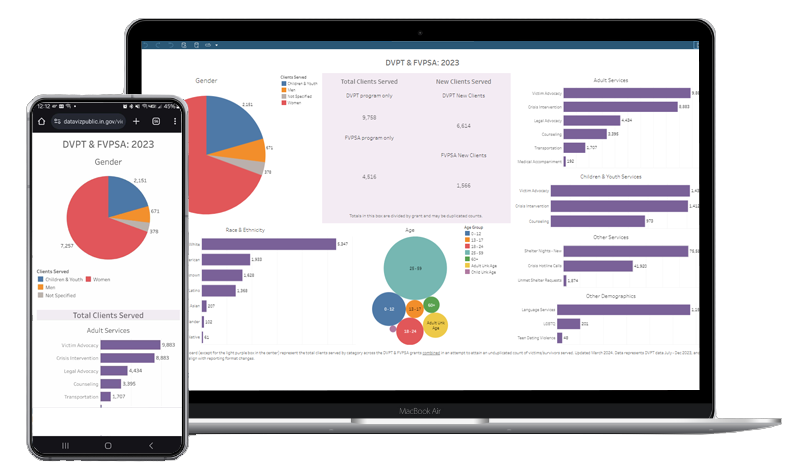
FVPSA Clients Served
As the State Administering Agency, the Indiana Criminal Justice Institute is responsible for administering FVPSA funds. Click the link below to see who is being served and what services are being delivered. This dashboard reflects quarterly program report data as entered by subgrantees and is combined with quarterly DVPT data.

Indiana Criminal Justice Institute