
From the Desk of Governor Schricker Part Two: The Days before Pearl Harbor
By Daniel Stearns, Reference Assistant
During Governor Henry F. Schricker's first term (1941-1945), Indiana maintained direct connections to global events through its religious institutions, immigrant communities, and educational networks abroad. The correspondence below exemplifies how World War II touched Indiana even before Pearl Harbor, as Hoosier missionaries witnessed the conflict firsthand. (For more on Governor Schricker, his role in coordinating Indiana’s WWII response, and this collection see From the Desk of Governor Schricker Part One).
This letter provides a glimpse into one of the battlefields of WWII that is often forgotten. It was written by a Lutheran missionary working at the Concordia Seminary located in Wanhsien (Wanxian) now Wanzhou, on the Yangtze River. Written two months before the attack on Pearl Harbor, the letter arrived on Governor Schricker’s desk having come from an active warzone. Chinese forces under the Nationalists or Kuomintang (KMT) and tentatively allied with insurgents of the Chinese Communist Party (CCP), where in their fourth year of resisting an invasion by the Japanese Imperial Army.
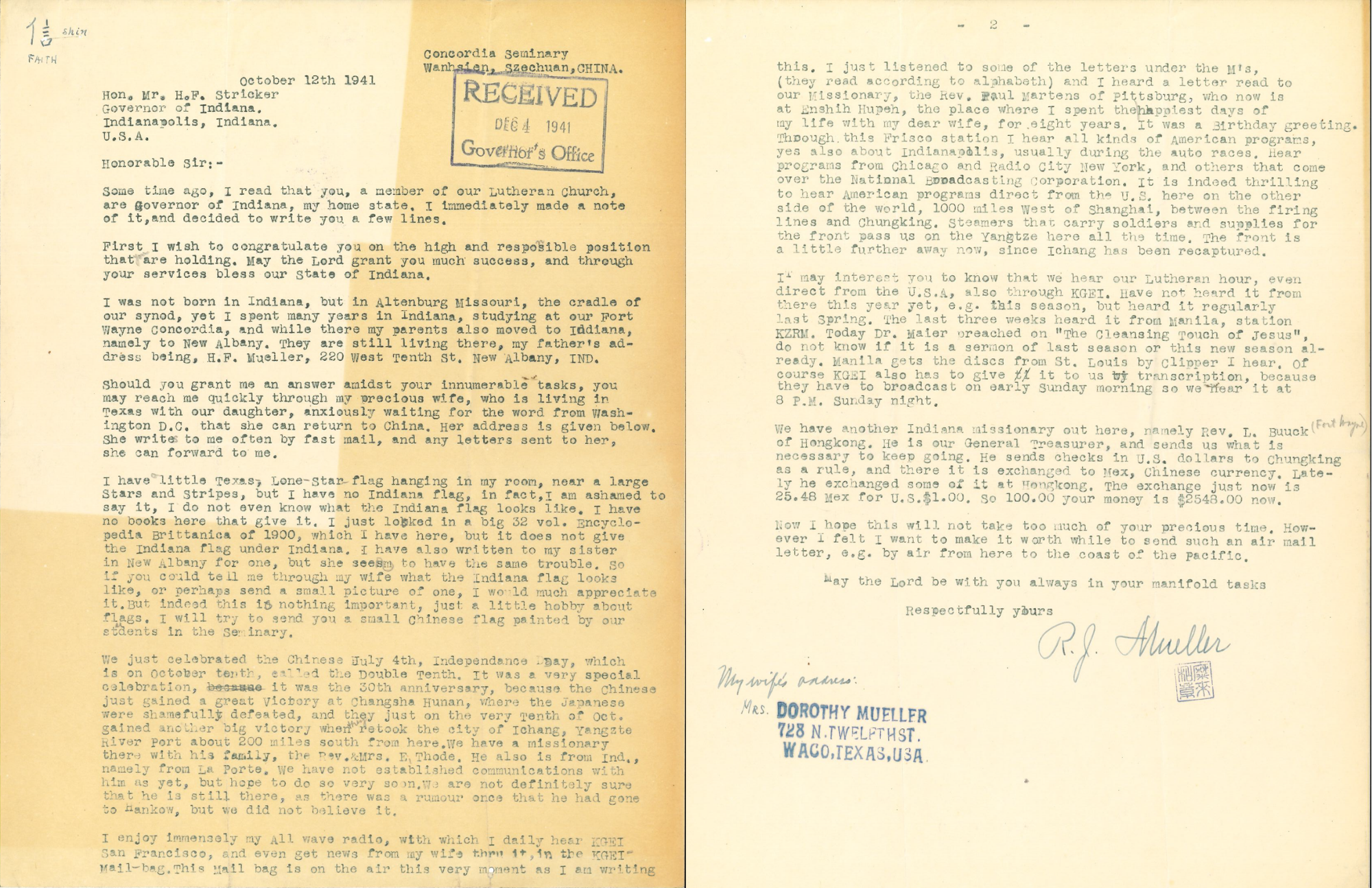
Image: R.J. Mueller to Henry F. Schricker, October 12, 1941, pages 1-2, Folder 13, Box 51, Papers of Governor Schricker, Indiana State Archives. View higher resolution scan of full letter.
The author, R.J. Meuller, describes two recent victories against the Japanese. From the seminary situated on the Yangtze River, he reports seeing soldiers and supplies being transported on steamers east to the front line, approximately 172 miles away. While Meuller himself is not from Indiana, he writes that he spent many years in Fort Wayne studying at the Concordia Seminary which still exists today. Meuller mentions other missionaries who are also from Indiana including a Reverend and his family from LaPorte and another from Fort Wayne. Indiana's strong Lutheran tradition, anchored by these local institutions, created lasting ties between the state and Lutheran missions worldwide. These connections provided Indiana leaders like Governor Schricker with unique perspectives on the global scope of the war that was already raging in Asia.
Included with the letter is a picture of a flag painted by a student at the seminary which some might correctly identify as the flag of Taiwan. However, in 1941, it was the flag of the KMT which was recognized globally as the legitimate government in China. Following the surrender of Japan in 1945, hostilities resumed between the Kuomintang and the CCP precipitating four more years of civil war. In 1950, the war ended with the retreat of the KMT from the Chinese mainland to the island of Taiwan setting shockwaves throughout the world amidst the dawn of the Cold War. The letter and the painting of the Chinese Nationalist flag offer a glimpse of what might have been had Chiang Kai-Shek and the KMT defeated the Chinese Communist Party.
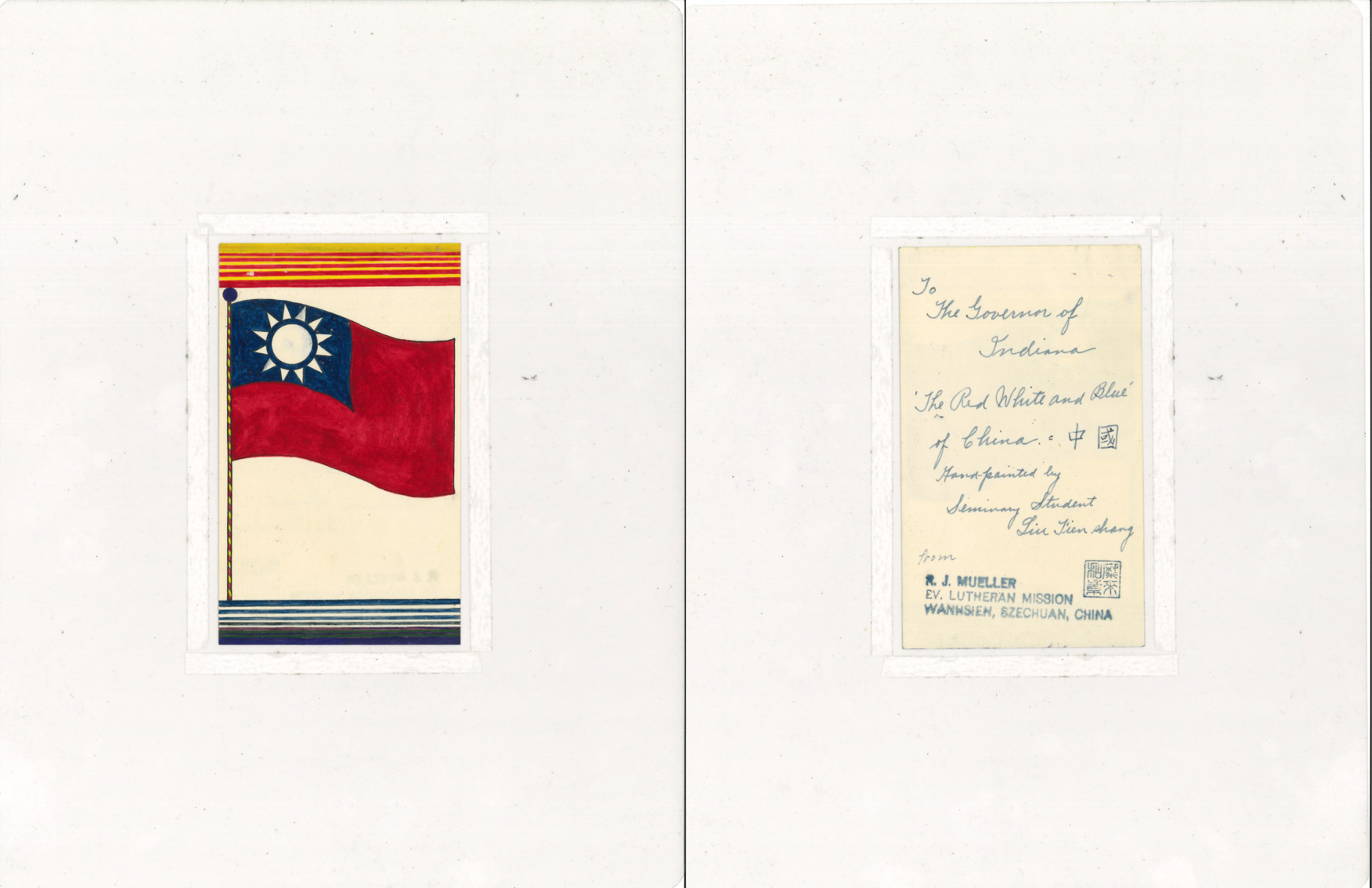
Image: R.J. Mueller to Henry F. Schricker, October 12, 1941, pages 3-4, Folder 13, Box 51, Papers of Governor Schricker, Indiana State Archives.
This correspondence from the Governor Henry F. Schricker Papers illustrates how Indiana's international connections provided state leaders with early insights into the global nature of World War II. The letter arrived at a time when many Americans still viewed the conflicts in Asia and Europe as distant concerns. However, for Governor Schricker, such communications helped underscore the reality that Indiana would need to prepare for a truly world war. The Indiana connections mentioned in Mueller's letter—through Concordia Seminary in Fort Wayne and missionaries from LaPorte—demonstrate how the state's religious and educational institutions created networks that would prove valuable during the war years for understanding international developments and maintaining morale among Hoosier families with loved ones serving overseas.